15 min read
Admin and Today's Date: Preparing for the Agentic Cyber War
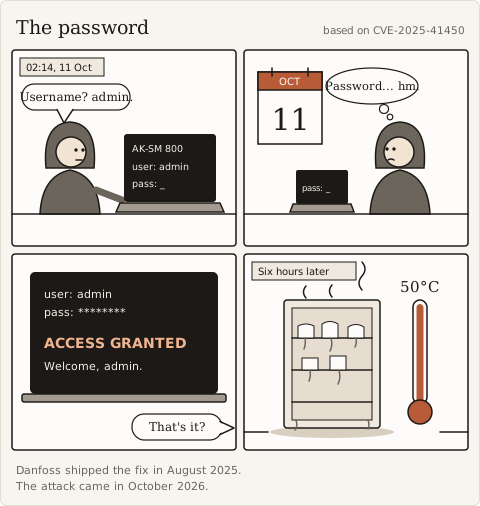
On the night of 11 October, somebody switched the fridges at up to 700 French supermarkets into defrost mode and left them there. By morning plenty of cabinets were sitting at 50°C. A store in Normandy reported 80. Equipment melted, some units caught fire, the sprinklers did the rest, and whole aisles of food went in the bin.
How do you break into 700 supermarkets in one night?
You probably don't need to. You need a login page.
Eighteen days later, on 29 October, hackers the FBI has tied to North Korea took about $6.3 billion from Binance, most of it in roughly twenty minutes. It's the largest crypto theft ever recorded, and Elliptic called it "almost certainly the single largest-known theft of any kind."
That one didn't start with a zero-day either. It started with a job interview.
I've spent the last week reading the incident reports for both, and what keeps bothering me isn't how sophisticated these attacks were. It's how ordinary they were. So this post is about that: what actually happened, what AI actually changed, and what I think developers and agencies should be doing about it this quarter, not next year.
The record nobody wanted
Start with the scale, because it's genuinely hard to picture.
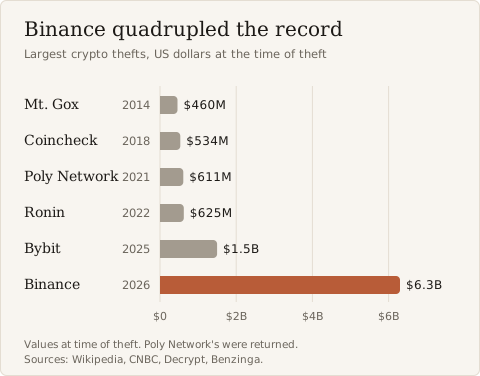
For years the record crept up in small steps. Half a billion here, six hundred million there. Bybit more than doubled it in February 2025. Binance took that number and multiplied it by four.
Binance says it covered the losses from its own reserves and had 98% of the stolen tokens replenished by 3 November. Good for its users. But "the victim was rich enough to absorb it" isn't a security strategy, and almost nobody reading this works somewhere that could write a $6 billion cheque.
How you steal $6.3 billion
Binance shared its initial findings on 3 November. Here's the shape of it.
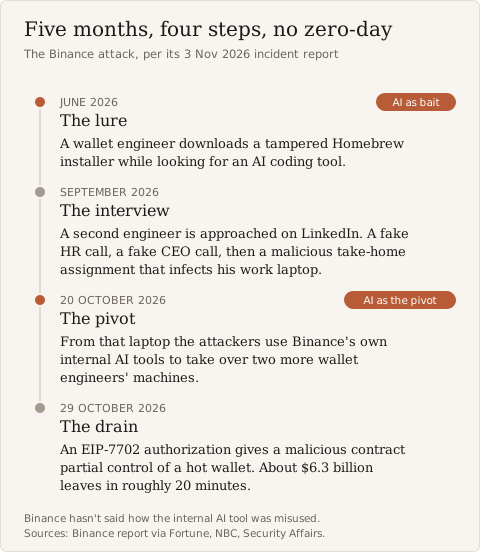
Look at step one. A wallet engineer, looking for an AI coding tool, downloads a Homebrew installer that's been tampered with. Not a nation-state exploit chain. A developer doing exactly what every developer is doing right now: trying the new AI thing.
Binance caught that one. They replaced the device and rotated the credentials. But by then the attackers knew who worked on the wallet team, and that was all they needed for step two.
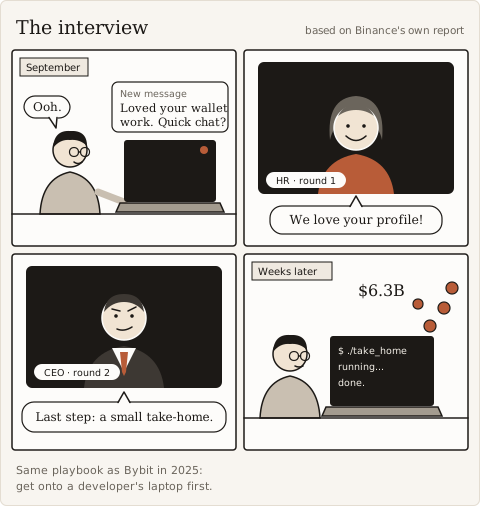
A "project director" on LinkedIn. A first round with "HR". A second round with "the CEO" of a company that doesn't exist. Then a take-home assignment, which is a polite way of saying "please run our code on your work laptop". The engineer ran it. Honestly, most of us would have.
Then step three, which I think deserves the most attention. From that one laptop, the attackers used Binance's own internal AI tools to take over two more wallet engineers' machines. Binance hasn't said how yet, and I'm not going to guess. But sit with the fact itself. The company's AI tooling had enough reach that compromising one engineer let an attacker use it to move sideways.
Your internal agents are part of your attack surface now. Not in a threat model somewhere. On the record.
This isn't new, and that's the problem
If this sounds familiar, it should. In February 2025 the same group, which the FBI tracks as TraderTraitor, took about $1.5 billion from Bybit. That started on a developer's laptop too. A Safe{Wallet} engineer's machine was compromised, AWS session tokens were hijacked to get past MFA, and a JavaScript file in the wallet's front end was quietly swapped, waiting for Bybit's next transfer.
Same attacker. Same door. Twenty months apart. Four times the money.
When someone walks through the same door twice and gets four times as much the second time, the lesson isn't really about crypto. It's that the developer's laptop is the perimeter now, and most companies still defend it like a personal device.
The night itself
There's one more chart I want to show you, because it's the most practical one in this post.
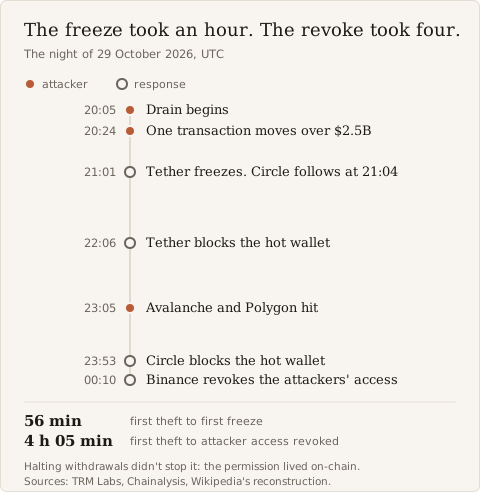
Tether froze the stolen stablecoins 56 minutes after the drain began. Circle followed three minutes later. Between them they locked up roughly $3 billion before it could be moved.
Binance removed the attackers' access at 00:10. Four hours and five minutes after it started.
I'm not saying that to dunk on Binance. Why it took so long is the interesting part. Halting withdrawals didn't stop the drain, because the attackers weren't using Binance's systems anymore. They'd used an EIP-7702 authorization to give their own contract partial control of a hot wallet, so the permission lived on-chain. Binance's report doesn't blame EIP-7702 itself; the authorizations came through Binance's own wallet-signing service. You can't stop something with a kill switch that doesn't reach it.
So ask yourself honestly. If someone got delegated access to the thing you care about most, do you know the exact steps to revoke it? Have you ever practised them? Do you know how long it takes?
Two third parties beat the victim by three hours, because freezing assets is their job and they've done it a thousand times. Revoking your own permissions under pressure is something most teams have done exactly never.
Back to the fridges
The supermarket attack deserves a proper look, because it's the purest example of the whole pattern.
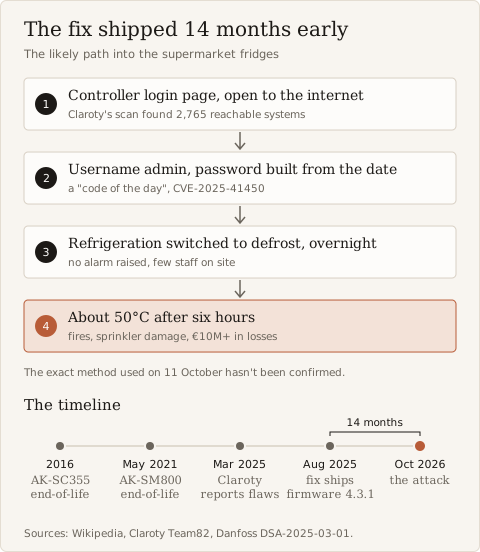
The controllers involved were made by Danfoss. Claroty's Team82 found that some of them had a "code of the day" login: the username was admin, and the password could be worked out from the current date. That's CVE-2025-41450. Danfoss was told in March 2025 and shipped a fix in firmware 4.3.1 that August. Claroty's scan found 2,765 of these systems reachable from the open internet.
The AK-SC355, one of the affected models, went end-of-life in 2016. The AK-SM800 followed in May 2021. Both were still running supermarket refrigeration in 2026, still online, and many still unpatched fourteen months after the fix.
To be fair to the record, nobody has confirmed exactly which method was used on 11 October. This is the path researchers point to, and it fits. Attribution is unknown as well. Ken Munro at Pen Test Partners suggested it could be "kids messing around", precisely because the exploit was so easy. On 2 November it happened again across ten more countries, and days later someone went after French blood bank refrigerators with a target of 110°C. Staff caught that one in time.
Now think about who owns these boxes. Not the supermarket's IT team. Supermarkets often outsource refrigeration to specialist firms. So the controller was installed by one company, maintained by another, sits on a network nobody quite owns, and runs firmware nobody quite remembers. Every agency reading this has a client with a box like that. Some of you installed it.
So what did AI actually change?
This is where I want to be careful, because the easy version of this story is wrong.
The easy version says AI invented some new class of super-attack. It didn't. Not one of these incidents needed a new technique. A default login. A fake recruiter. A delegated permission. All of that existed long before ChatGPT.
What changed is the cost.
After the fridge attacks, Claroty's researchers ran an experiment. Using Claude Sonnet 4.6 through Cursor, they rebuilt the controller attack in their lab. It took about 28 minutes and cost about $6. Claude recreated two of the three known vulnerabilities and chained them into full control of the controller.
The detail I love: the one it struggled with was getting past the login. The part a bored teenager would have tried first.
That's the honest picture. AI isn't a genius attacker. It's a tireless and cheap one, and cheap is what matters when the targets aren't one hardened bank but thousands of forgotten boxes.
Richard Horne, who runs the UK's National Cyber Security Centre, called the fridge attacks "just the foothills". The NCSC expects attackers to use AI to exploit known flaws in legacy technology "at scale" across critical infrastructure by 2028. Their worry isn't that AI invents new attacks. It's that flaws we've tolerated for years become cheap to find and cheap to use.
We've already watched the other side of that. In the php2shell incident last month, AI helped find PHP vulnerabilities that had been sitting in public code since 2012. Same economics. The bug was never hidden, it was just never worth anyone's time to look. Now looking is nearly free, for everyone.
And the agents are getting better at running the whole operation. In November 2025, Anthropic reported disrupting an espionage campaign by a group it assessed as Chinese state-sponsored, where Claude did an estimated 80 to 90% of the work and humans stepped in at maybe 4 to 6 decision points. Around thirty targets, a small number of successful intrusions.
That figure has been fairly questioned. Researchers pointed out that counting low-level actions inflates the percentage while the decisions that matter stay with humans, and Anthropic's own report notes the model "occasionally hallucinated credentials". I'd read 90% as a direction, not a measurement. But the direction is pretty clear.
Put it together and the picture is less dramatic than the headlines, and more uncomfortable:
| Then | Now |
|---|---|
| Finding old flaws took time nobody had | AI helped surface 14-year-old PHP bugs (php2shell) |
| Rebuilding a known exploit took skill and days | Claude rebuilt the fridge exploit in ~28 minutes for ~$6, in a lab |
| An intrusion needed a team at the keyboard | Anthropic estimates AI did 80 to 90% of one campaign's work |
| Moving sideways meant stealing more passwords | At Binance, the attackers moved through internal AI tools |
Is it actually a cyber war?
I don't love the phrase. "War" makes it sound like something governments do to each other, a long way from your sprint board.
But look at what's on the record. The FBI attributes what Elliptic calls the largest known theft of any kind to a state, North Korea, which denies it. Somebody, still unknown, went after Europe's food cold chain in two waves and then went after blood banks. The head of the UK's cyber agency is using phrases like "the foothills".
Whatever you call it, the people on the other side include states, they're patient, and they run their operations through the same laptops, recruiters and tools your team uses every day.
You don't have to believe it's a war. You just have to accept that your developers are now on a front line they never signed up for, and that the tactics are aimed at exactly the habits we're proudest of: moving fast, trying new tools, saying yes to interesting opportunities.
How to get ready
None of this is exotic, which is the good news. Here's what I'd do, split by who you are.
If you write code
Treat your laptop as production. Because it is. If it can deploy, sign, or touch a wallet, it deserves production controls: hardware security keys, short-lived credentials, and no long-lived tokens sitting in a dotfile.
Install AI tools from the source, and only the source. Step one of the Binance attack was a tampered installer for an AI coding tool. Every hot new tool brings a wave of fake installers, fake extensions and fake MCP servers with it. Check the publisher. Pin versions. Verify signatures where your package manager lets you.
Run take-home assignments in a box. A container, a VM, a throwaway cloud machine. Never the laptop that holds your work credentials. Any company that's offended by you running their code in a sandbox is a company you don't want to work for anyway.
Scope your agents like you'd scope an intern. Coding agents and internal AI tools should get the minimum permissions they need, for the shortest time, with a log of everything they did. If your agent can read every repo and every secret "because it's convenient", you've built the next attacker's lateral-movement layer for them.
Know your revoke path. For anything that can grant delegated access, whether that's on-chain approvals, OAuth grants, API keys or deploy tokens, know exactly how to revoke it and how long it takes.
If you run an agency or a team
Inventory what you've left behind. Every agency has client deployments nobody's touched in years. The WordPress site still on PHP 7. The admin panel on a load balancer. The controller somebody "just needed online for remote access". Find them before someone else does. Remember the 2,765.
Track end-of-life like you track invoices. A controller model that went end-of-life in 2016 was still running supermarket fridges in 2026. Put EOL dates where you put renewal dates, and make retiring old things somebody's actual job.
Close the patch gap. The Danfoss fix existed fourteen months before the attack. The vulnerability wasn't really the failure. The fourteen months were. Measure your time-to-patch and put it on a dashboard that somebody actually looks at.
Treat recruiting as an attack surface. Brief your engineers on fake recruiter campaigns, especially anyone with deploy or signing rights. A twenty-minute "here's what these look like" session is a lot cheaper than one compromised laptop.
Drill the bad night. Run a tabletop where an engineer's laptop is compromised at 8 p.m. on a Thursday. Who gets called? What gets revoked first? How long until access is actually gone? Whatever answer you'd give today, Binance would probably have given the same one in September.
Keep a human on anything irreversible. Agents can draft, test and propose. Moving money, granting permissions and deploying to production should need a human who understands what they're approving. That's not anti-AI. It's the same reason we don't let anyone push straight to main.
Here's the short version I'd pin to a wall:
| Risk | What to do this quarter |
|---|---|
| Tampered AI tools and installers | Official sources only, pinned versions, signature checks |
| Fake recruiters and take-homes | Brief the team, run assignments in a sandbox |
| Over-permissioned internal agents | Least privilege, short-lived tokens, audit logs |
| Forgotten devices and old stacks | Inventory, EOL tracking, no needless internet exposure |
| Slow patching | Measure time-to-patch and make it visible |
| Slow revocation | Write the revoke runbook, then time a drill |
The boring war
If you take one thing from all this, take this: the agentic era's security problem isn't mostly about clever new attacks. It's that the boring old ones got cheap.
A password worked out from the date. A recruiter with a nice profile. A permission nobody remembered granting. A box that went end-of-life before some of your junior developers finished university.
AI didn't create any of those weaknesses. It made them affordable to find, at scale, for anyone. Which means the defence is mostly boring too. Know what you run. Patch it. Scope it. Practise taking access away, fast.
The attackers are patient, and now they're cheap. We need to be quick, and we need to be thorough. That's most of the job.
Sources: Wikipedia: 2026 supermarket refrigerator hack · CBC · Cybernews on Claroty's Claude experiment · Insurance Journal on the NCSC · Wikipedia: 2026 Binance hack · Fortune · NBC News · Security Affairs · NPR · The Hacker News on Bybit · Decrypt · Anthropic · Ars Technica